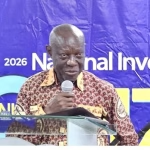
Founder of Fidelity Bank Group, Edward Effah, has called for a $25 billion investment mobilisation programme over the next five years, arguing that Ghana must move beyond macroeconomic recovery and focus on industrialisation, job creation and export growth.
Speaking at the 10th Ghana CEO Summit on the theme, “The CEO-Government Compact 2026: Accelerating Ghana’s Economic Transformation,” Mr. Effah said the country had made significant progress in restoring economic stability but warned that stability alone would not guarantee sustainable development.
According to him, Ghana must now pursue what he described as a “Big Push” agenda, built on a structured partnership between government and the private sector to transform the economy and position the country as West Africa’s leading industrial and digital hub.
“Ghana now needs more than stability. Ghana needs a Big Push for economic transformation, a bold national agenda that brings government and business into a structured partnership to build the future we want together,” he said.
Mr. Effah noted that Ghana’s economy had nearly doubled in size over the past decade, growing from approximately $56 billion in 2016 to an estimated $115 billion today, making it the eighth-largest economy in Africa.

However, he argued that economic expansion had not translated into sufficient job creation or structural transformation.
He pointed to recent economic improvements, including the appreciation of the cedi, inflation declining to 3.3 percent, international reserves increasing to $13.8 billion, and the debt-to-GDP ratio falling to 45.3 percent.
“Stability has been restored. It is now time for transformation. Stability creates the conditions for progress, but it does not guarantee progress,” he stated.
Drawing lessons from previous periods of economic recovery, Mr. Effah cautioned against assuming that stability would automatically lead to industrial take-off.
He recalled that Ghana was similarly considered ready for rapid growth following economic reforms in the 1990s, yet failed to achieve the expected transformation.
Central to his argument was Ghana’s growing youth employment challenge. He estimated that about 1.5 million young people are currently not in employment, education or training, while roughly 500,000 additional young people will enter the labour market each year over the next decade.
Without significant investment and job creation, he warned, the number of unemployed youth could rise sharply in the coming years.
“If we are to create jobs at the scale this moment demands, then it cannot be business as usual,” he said.
To address the challenge, Mr. Effah urged policymakers and business leaders to prioritise technical and vocational training, entrepreneurship development, digital skills acquisition and stronger collaboration between industry and educational institutions.
He also highlighted opportunities presented by regional integration, noting that Ghana sits at the centre of a West African market of more than 400 million consumers with an estimated combined GDP of $650 billion.
The African Continental Free Trade Area (AfCFTA), he said, provides Ghana with a unique opportunity to build competitive industries in pharmaceuticals, financial services, healthcare, logistics, education, consumer goods, energy and digital infrastructure.
However, he stressed that success would require deliberate planning and coordinated action.
“We will capture the opportunity if and only if we are intentional, coordinated and ambitious in a common transformation agenda,” he said.
Mr. Effah identified digital transformation as another key driver of future growth. While welcoming Ghana’s National Artificial Intelligence Strategy, he expressed concerns that aspects of the proposed National Information Technology Agency (NITA) Bill may not adequately support innovation, start-ups and private-sector participation.
He noted that Ghana has already established itself as a regional leader in digital payments, fintech innovation and digital public services, with approximately 26 million active mobile money accounts nationwide.
To drive implementation, Mr. Effah proposed the creation of a National Economic Transformation Council chaired by the President to oversee reforms, remove bottlenecks and monitor progress on strategic projects.
He also called for a dedicated Transformation Delivery Unit staffed by professionals to coordinate investments and policies across priority sectors including agriculture, manufacturing, energy, technology, infrastructure and finance.
“Strategy matters, but it is delivery and execution that changes nations,” he said.
To ensure continuity beyond election cycles, he recommended that the proposed compact be backed by legislation, protected funding mechanisms and annual public performance scorecards.
Mr. Effah argued that Ghana’s private sector has repeatedly demonstrated its ability to deliver national projects, citing the COVID-19 Private Sector Fund’s rapid construction of the Ghana Infectious Disease Centre and the mobilisation of billions of cedis through ESLA bonds to support the energy sector.
He said Ghana should target mobilising approximately $25 billion in investment over the next five years, equivalent to around five percent of GDP annually to support industrial growth and employment creation.
The financing, he suggested, should come from a blend of public investment, commercial bank lending, pension and insurance funds, development finance institutions and foreign direct investment.
According to him, Ghana’s challenge is not necessarily a shortage of capital but rather how available capital is allocated.
“Historically, too much of our local savings has been channelled into treasury bills, government bonds and non-productive assets, while the sectors that can transform the economy remain underfunded,” he said.
He stressed that maintaining fiscal discipline and lower interest rates would be critical to redirecting capital into productive sectors capable of driving growth.
For Ghana to achieve its long-term ambitions, Mr. Effah said the country must aim for annual economic growth of between seven and 10 percent, a stronger manufacturing base, higher export earnings, lower youth unemployment and greater foreign exchange stability.
He concluded that the country’s next challenge is not restoring stability but building the institutions and partnerships necessary to convert stability into jobs, investment, exports and shared prosperity.