

Africa’s financing problem may not simply be a shortage of capital but a mismatch between the kind of money available and the kind of investments the continent needs.
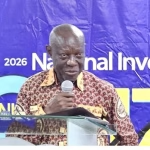
This is the view of the Managing Director of GCB Bank, Farihan Alhassan, who was speaking at the African Leadership Council.
Farihan Alhassan argued that Africa needs smarter, more patient capital structures that allow commercial banks, development finance institutions and investors to finance long-term growth without putting the financial system under unnecessary liquidity pressure.
Short Money, Long Projects: Africa’s Problem
The GCB Bank MD maintains that the problem is built into how banks operate. Commercial banks are largely funded with relatively short-term deposits, but many of the businesses and infrastructure projects they are expected to finance require money for five, 10, or even 20 years.
This, he says, creates a basic mismatch. A bank cannot sustainably use money that could be demanded by depositors tomorrow to finance a project that may not generate meaningful returns for many years.
For instance, he imagines borrowing someone’s money for six months and lending it to a business that will only start generating significant cash flow after five years. The business may be excellent, but the financing structure is wrong.
This is the problem Farihan Alhassan wants Africa to solve.
Bring DFIs into the Equation
His proposed answer is closer cooperation between commercial banks and development finance institutions (DFIs). He believes that DFIs can help provide longer-term funding, guarantees, risk-sharing mechanisms or other forms of patient capital that allow commercial banks to participate in projects without carrying the entire maturity risk on their balance sheets.
This would give businesses access to financing better suited to the lives of their projects. A factory should not have to rely on financing designed for a short-term trading cycle.
A major infrastructure project should not depend entirely on funding structures built around short-term deposits.
Capital Must Come Back to Work
Farihan Alhassan further argues that capital must be structured in a way that allows it to be recycled. Banks and investors are not simply deploying money once. They need returns from today’s investments to finance tomorrow’s businesses.
When the financing structure is too short, too expensive or poorly matched to the project, that cycle breaks down. Capital becomes trapped, stressed or withdrawn before the underlying investment has had enough time to produce returns.
The result is fewer businesses financed, fewer projects completed and less capital available for the next generation of entrepreneurs.
The Real Opportunity is Smarter Capital
This is why Mr Alhassan believes Africa should move beyond the familiar demand for “more capital.” The continent certainly needs investment, but the bigger question is how that investment is structured.
He believes the structure should encompass more patient funding, better risk-sharing, longer maturities, closer bank-DFI partnerships, and financing costs that reflect actual risk rather than perception.
These changes, he argues, could allow the same pool of capital to finance more businesses over time.


