
The Securities and Exchange Commission (SEC) is proposing the establishment of an infrastructure development corporation to mobilise part of Ghana’s growing pension funds for long-term infrastructure projects while reducing reliance on government borrowing.
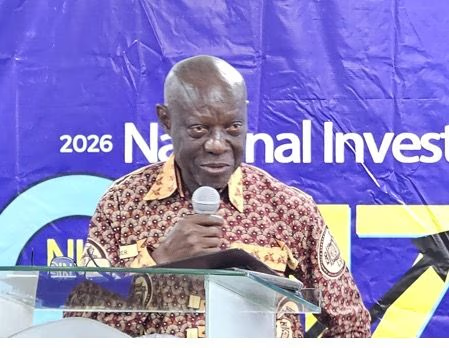
Chairman of the SEC, Dr. Adu Anane-Antwi, said the proposed corporation could bring together government and private investors to finance infrastructure through bonds issued on the corporation’s own balance sheet.
He said the structure would enable major infrastructure projects to attract long-term institutional capital without the financing being treated as direct government borrowing.
Dr. Anane-Antwi also proposed limiting government’s ownership of the corporation to 20 percent to reduce concentration risk and encourage stronger private-sector participation.
He made the proposal at the launch of the National Investment Quiz Competition at the Ghana Stock Exchange (GSE) in Accra.

The proposal comes as Ghana’s pension industry continues to expand, with assets under management now estimated at about GH¢120 billion, creating an urgent need for more attractive domestic investment opportunities.
The growing pool of institutional funds has also increased pressure on fund managers to identify assets that can generate competitive returns while improving portfolio diversification.
The challenge has become more significant following restrictions on overseas investments by Collective Investment Scheme (CIS) fund managers.
Effective February 4, 2026, CIS fund managers licensed to invest locally have been restricted from investing more than 20 percent of funds under management in foreign assets.
Fund managers previously authorised to invest up to 100 percent of their portfolios in foreign securities are now required to cap such investments at 70 percent, effectively requiring at least 30 percent of their assets to remain invested domestically.
The SEC has said the measures are intended to reduce capital outflows and support the stability of the cedi.
However, the restrictions have raised concerns among fund managers over limited diversification opportunities and the potential for excessive concentration in government securities, given the shortage of alternative high-yield assets in the domestic market.
Dr. Anane-Antwi acknowledged the supply-side challenge, warning that the rapid growth of pension funds could create concentration risks if most of the money ends up being invested in government bonds.
“But that also causes a concentration risk as all the money will be given to government in bonds. If we don’t do that, the pension funds will be there and we will not have any products to invest in,” he said.
He said pension contributions continued to grow every month, making it increasingly important for Ghana to develop new domestic investment products capable of absorbing the funds.
“We should be looking at what we can develop for them to invest in locally,” he said.
Against this backdrop, the SEC chairman identified infrastructure as a potentially large-scale investment opportunity for pension funds and other institutional investors.
He said government should increasingly use private capital to help close Ghana’s infrastructure financing gap rather than depending predominantly on public borrowing.
Dr. Anane-Antwi cited the Tema Motorway as an example of an infrastructure asset that could potentially have been financed through bonds backed by private and institutional investors.
He argued that the road’s ability to generate revenue could have provided a mechanism for investors to recover their capital over time.
“If Ghanaian companies or investors had provided bonds to construct it, it would have been repaid long ago,” he said.
He said a dedicated infrastructure financing vehicle could therefore address two challenges simultaneously: mobilising capital for critical infrastructure while creating long-term investable assets for pension funds and other institutional investors.
“So that’s the concept which I think if we follow it will help us develop our infrastructure and also get these pension funds an avenue to invest,” he said.
The proposal places infrastructure finance at the centre of efforts to deepen Ghana’s capital market, diversify investment opportunities and ensure that the country’s expanding pool of long-term savings contributes more directly to economic development.


