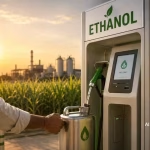
Amid the calls for government intervention following the “galloping” prices of fuel in recent days, the Presidency, on Monday, announced that President Mahama has ordered a GH₵2.00 per litre cut in the regulatory margin on diesel.
This subsidy, according to the announcement, is effective Tuesday, August 4, for one month. It is worth noting that unlike the earlier intervention, Petrol and LPG were left out entirely.
The Presidency’s letter, signed by Government Communications Minister Felix Kwakye Ofosu, says the move is a repeat of “the successful intervention implemented in April 2026,” designed to “cushion consumers, prevent transport fare hikes, contain inflationary pressures, and mitigate the pass-through effect of higher fuel prices on the cost of living.”
As indicated, April’s intervention wasn’t diesel-only. When Cabinet first rolled out fuel relief that month, it absorbed GH₵2.00 on diesel and GH₵0.36 on petrol, an intervention later scaled down to GH₵1.07 on diesel through May. This time, petrol and LPG aren’t mentioned at all.

So why has diesel, alone, earned the government’s attention four months later?. This is where the inflation factor comes in.

The Inflation Fear
Ghana’s inflation climbed to 5.3% in June, its third straight monthly rise, up from 3.7% in May and 3.2% in March. The Bank of Ghana has already held its policy rate at 14% this cycle, citing fresh inflation risk tied to the US-Iran conflict and its effect on global oil prices.
Then came Fitch Solutions, whose Associate Director Mike Kruiniger told a PwC Ghana webinar on the Mid-Year Budget Review that inflation could climb to 9% by the end of 2026, and to 13.2% by the end of 2027, well above the Finance Minister’s own projection of 5% by December.
Fitch’s reasoning centres on a Ghana cedi it doesn’t expect to hold its recent strength, which would push up the cost of imports, including fuel.
Considering the inflationary pressure makes the diesel-only subsidy hard to ignore, considering the significant impact it could have on the headline. In other words, this subsidy could be viewed as a calculated bet to guard the economy from being plunged into runaway inflation.

Why Diesel Might Matter More Than Petrol & LPG
For many with significant knowledge about Ghana’s commercial transport industry, diesel isn’t just a fuel choice. It is the fuel of Ghana’s informal transport and logistics backbone. A significant share of trotro and commercial vehicle fleets run on diesel, and so does most of the country’s cargo haulage, the trucks moving tomatoes, cassava, maize and imported goods from farm gates and ports to markets across the country.
When diesel prices spike, it isn’t just fuel that gets pricier; an accompanying increase in transport fares will have a significant impact on the economy. Already, commercial drivers are threatening a 30% hike in transport fares prior to the subsidy announcement.
Should this happen, the cost will trickle down to affect the prices of food and goods rise with it. This feeds directly into the food and transport components that carry the heaviest weight in Ghana’s consumer price index.

Petrol, by contrast, is more heavily tilted toward private saloon cars and taxis, a narrower, comparatively higher-income slice of fuel consumption whose price movements arguably transmit less forcefully into headline inflation.
LPG, used mainly for household cooking, has its own price sensitivity, but a less direct route into the transport-and-logistics chain that determines how much a tomato costs by the time it reaches Makola or Kejetia.
Seen this way, a GH₵2 cushion on diesel alone could be read as a targeted attempt to keep transport fares and cargo rates from moving. This is on the theory that if fares and haulage costs stay put, whatever inflationary sting comes from petrol and LPG price increases elsewhere in the economy may struggle to fully pass through to the general price level, and by extension, to the Bank of Ghana’s inflation target and its next Monetary Policy Committee decision.