
By using this site, you agree to the Privacy Policy and Terms of Use.
Accept
The High Street Journal
  • HOME
  • BUSINESS & ECONOMY
  • NEWS & UPDATES
  • WORK & CAREERS
    • THSJ Resources
  • LEGAL INSIGHTS
  • INNOVATION
  • OPINIONS
  • #STOPGALAMSEY
The High Street JournalThe High Street Journal
Search
  • HOME
  • BUSINESS & ECONOMY
  • NEWS & UPDATES
  • WORK & CAREERS
    • THSJ Resources
  • LEGAL INSIGHTS
  • INNOVATION
  • OPINIONS
  • #STOPGALAMSEY
Follow US
© 2024 | The High Street Journal. All Rights Reserved.
Business & Economy

Is Ghana Really Gaining from Trade, or Is Inflation Masking the Truth?

Ghana's trade surplus in nominal terms masks a real trade deficit in 2024, highlighting inflation and exchange rate effects that distort actual trade performance and economic gains

Is Ghana Really Gaining from Trade, or Is Inflation Masking the Truth?
Solomon Boakye
Mar 1, 2025

Ghana’s trade performance in 2024 presents a striking contradiction. On paper, the country recorded a nominal trade surplus of GH₵44.7 billion, but in real terms, trade ended in a deficit of GH₵4.7 billion. This disparity raises a critical question: is Ghana truly benefiting from trade, or are inflation and currency depreciation distorting the numbers?

Trade data over the past three years shows Ghana maintained a real trade surplus, with GH₵1.9 billion in 2022 and GH₵1.4 billion in 2023. However, this trend reversed in 2024, with import volumes outpacing exports when adjusted for inflation. 

In nominal terms, Ghana’s total trade value surged to GH₵545.1 billion in 2024, compared to GH₵366.6 billion in 2023. Exports stood at GH₵294.9 billion, while imports reached GH₵250.2 billion. But when adjusted for inflation, total trade flow was significantly lower at GH₵200.6 billion, with exports at GH₵98.0 billion and imports at GH₵102.7 billion.

According to the Ghana Statistical Service (GSS) trade report, “In 2024, Ghana’s real trade values was a deficit of GH₵4.7 billion, in contrast a trade surplus of GH₵44.7 billion recorded in nominal terms. Having recorded real trade surpluses in 2022 (GH₵1.9 billion) and 2023 (GH₵1.4 billion), the trade balance returned to a deficit of GH₵4.7 billion in 2024.”
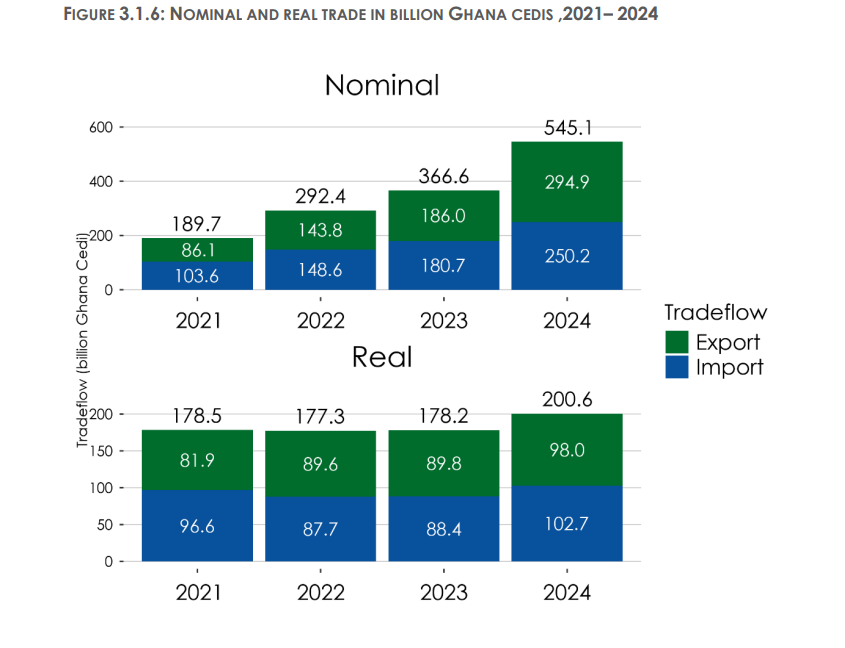
The difference between nominal and real trade is crucial. Nominal trade values measure the total value of goods and services traded at current market prices. However, inflation and currency depreciation can artificially inflate these figures. 

READ ALSO

More Hours, Same Inefficiencies: The Challenge Facing Ghana’s 24-Hour Economy
GNCCI: Private Sector Must Turn Economic Stability into Growth
Newmont Commits US$15m to Ghana’s Tree for Life Initiative

Real trade values, on the other hand, strip out the effects of price changes to reflect the actual volume of goods exchanged. The fact that Ghana recorded a real trade deficit in 2024 despite a large nominal surplus suggests that rising prices and exchange rate depreciation have distorted trade performance.

Is Ghana Really Gaining from Trade, or Is Inflation Masking the Truth?

One of the key factors that could be driving the inflationary impact on trade is the depreciation of the Ghanaian cedi against major foreign currencies. A weaker cedi makes imports more expensive, inflating their nominal values even if the actual quantity of goods imported remains stable or declines. Similarly, export earnings in cedi terms appear larger due to exchange rate effects, even if the volume of goods exported has not increased significantly.

Another major factor is domestic inflation, which affects the cost of production and trade. High inflation raises the prices of goods and services, making Ghanaian exports less competitive in international markets. At the same time, it increases the cost of imported goods, leading to higher trade expenditures without necessarily reflecting increased economic output.

While the nominal surplus may suggest a strong trade position, the reality is that inflation and currency depreciation have eroded the gains. 

Share this:

  • Share on X (Opens in new window) X
  • Share on Facebook (Opens in new window) Facebook
Advertisement

Like this:

Like Loading…

Related

Subscribe to Our Newsletter
Subscribe to our newsletter to get our newest articles instantly!
[mc4wp_form]
Share This Article
Facebook Whatsapp Whatsapp LinkedIn Email
Previous Article Ghana's Economic Dialogue, A Symbolic Gesture or a Genuine Attempt at Citizen Engagement? Mahama’s Economic Magic, Treasury Bill Rate Plummet: A shot in the Arm for Ghana’s Economic growth?
Next Article The Legacy of Alhaji Asoma Banda: A Life of Enterprise, Philanthropy, Politics & Nation-Building Business Mogul Alhaji Asoma Banda Passes On
Advertisement

LATEST NEWS

CSOs Question Gaps in Gov't's US$2.2bn Energy Investment Plan
CSOs Question Gaps in Government’s US$2.2bn Energy Investment Plan
News
Ghana’s Climate Leadership Must Translate into Domestic Energy Reforms—NRGI
News
Global Aid Transparency Stalls as AI Exposes Gaps in Development Funding Data
Global Perspectives & Leisure Innovation
“I Am Honored to Return”: Jensen Huang Reinstated as Nvidia CEO
Global Perspectives & Leisure Innovation
Newmont’s Ghana Spending Tops US$1bn as Company Retains Top Corporate Ranking
News

You May Also Like

Gold & Cocoa Fire Ghana’s Int’l Trade as Trade Surplus Rises to 4.4% of GDP in April 2026

Ghana’s 2024 Trade Report Reveals Heavy Reliance on Gold, Oil, and Cocoa Exports

NIB Intercepts Cocoa Smuggling Attempt in Oti Region

Until NPLs Are Cut to 10%, Amending Lenders & Borrowers Act Could Be an Exercise in Futility – Dr. Atuahene

BoG Considering 7-Day Bill to Strengthen Liquidity Management as Inflation Fight Continues

DStv–GTV Banter Becomes a Real-Time Marketing Playbook for Ghanaian Brands 

Burundian President Ndayishimiye Invites Ghanaian Investors to Explore Key Growth Sectors

Burundian President Ndayishimiye Invites Ghanaian Investors to Explore Key Growth Sectors

Breaking the Odds: Ghanaian Women Speak Out on the Hidden World of Sports Betting

Breaking the Odds: Ghanaian Women Speak Out on the Hidden World of Sports Betting

Commitment to Ban Raw Material Exports by 2030: Bold Initiative, But Will Walking the Talk Come Cheap?

Commitment to Ban Raw Material Exports by 2030: Bold Initiative, But Will Walking the Talk Come Cheap?

Inflation

Producer Inflation Slows to 18.5% in April, Signaling Cost Relief for Industry

The High Street Journal

About Us

Delivering focused and insightful business perspectives; impacting lives.

Email: [email protected]

Useful Links

  • About
  • AI Strategy & Policy
  • Advertise
  • User Policy
  • Be a Guest Author
  • Contact Us
  • Sitemap

Stay Connected

© 2026 | The High Street Journal. All Rights Reserved.

Loading Comments...
%d