
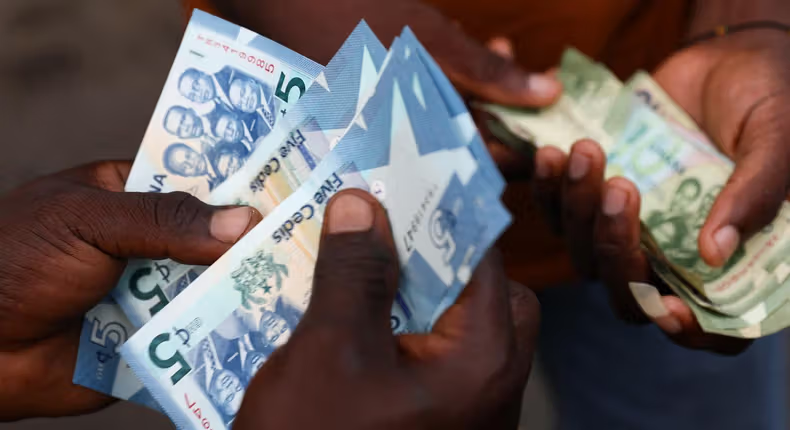
For some time now, Ghanaian entrepreneurs and businesses looking to expand a shop or the families in need of credit, the cost of loans has been becoming more affordable.
According to the Bank of Ghana’s May 2026 Summary of Economic and Financial Data, the average lending rate dropped for the fourth consecutive month in 2026, reaching 16.33% in April.
This downward slide, from a staggering 27.40% just one year ago, represents a significant easing of the financial burden on the private sector.
However, while the trend is positive, a new decision by the central bank’s Monetary Policy Committee (MPC) suggests that the era of rapid rate cuts may be coming to a tentative halt.
Policy Rates and the Reference Rate
READ ALSO

The steady decline in what banks charge you for a loan hasn’t happened by accident. It is the result of a deliberate “domino effect” started by the Bank of Ghana.
Over the past year, the central bank aggressively slashed its Monetary Policy Rate (MPR) from 28.00% in mid-2025 to 14.00% by March 2026. This policy shift passed directly through to the Ghana Reference Rate (GRR), which is the benchmark that banks use to price their loans.
As a result of the Domino Effect, the GRR has plummeted from 23.99% in April 2025 to a mere 10.06% in April 2026.
As the GRR dropped, commercial banks were forced to follow suit, leading to the current 16.33% average lending rate.
This means that, for a business taking a GHC 100,000 loan, the shift from 27% to 16% means thousands of cedis saved in interest payments every month. These savings can now be reinvested into hiring or equipment.
Relatively High, but Heading in the Right Direction
Despite this progress, it is important to keep things in perspective. While 16.33% is the lowest we have seen in years, it remains relatively high compared to many emerging markets, continuing to eat into the profit margins of local businesses.
The gap between the 10.06% reference rate and the 16.33% actual lending rate shows that banks are still pricing in significant risks when lending to the public.
A Warning Signal: The MPC Pause
The biggest threat to this recovery is the latest decision from the MPC. After months of consistent cuts, the committee chose to maintain the Monetary Policy Rate at 14.00% in May 2026 after its 130th MPC meeting.
This ‘hold’ signals that the central bank may be worried about underlying inflationary pressures or global economic volatility. By stopping the cuts to the policy rate, the Bank of Ghana has essentially removed the primary engine that was driving lending rates down.
If the policy rate stays flat, the Ghana Reference Rate is likely to stabilize, which could stall the downward trend in lending rates just as they were becoming truly competitive.
What This Means for You
While the current 16.33% is a breath of fresh air compared to the stifling rates of 2025, the MPC’s recent caution suggests that further relief might be slow to arrive.
As Ghana continues its economic recovery, the hope is that the stability achieved so far will eventually allow the central bank to resume its downward trajectory. For now, however, the cheap money sprint has slowed to a crawl.
The market will be watching the next MPC meeting closely to see if the progress of 2026 will be preserved or if the downward trend has officially hit a floor.


