When Ghana’s Black Stars step onto the pitch against Panama in their opening match of the 2026 FIFA World Cup, they will be playing before one of the largest global audiences ever assembled for a sporting event. But while the players compete for points, Ghana’s embassies abroad have an opportunity to compete for something equally valuable: investment.
The World Cup is not just football. It is one of the world’s largest gatherings of capital, corporate executives, policymakers, diaspora communities, development financiers and global media. For a month, cities across North America become hubs where business meetings, networking events and investment discussions take place alongside matches.
For Ghana, that creates a rare window to showcase itself not merely as a football nation but as an investment destination.
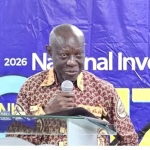
The Ghana Investment Promotion Centre (GIPC) appears to understand this reality. Ahead of Ghana’s opening match, it is hosting the World Cup 2026 edition of the Invest Ghana Business Forum at the Ontario Investment and Trade Centre in Toronto.
The event brings together investors, businesses and stakeholders to explore opportunities across agribusiness, manufacturing, tourism, financial services and export-oriented industries. More than 30 exhibitors are expected to showcase Ghanaian products and services, while the government’s flagship 24-Hour Economy and Accelerated Export Development Programme will be presented to potential investors.

The timing is strategic. Global sporting events create concentrations of people and capital that rarely occur under normal circumstances. Countries that align investment promotion activities with these events gain access to audiences that would otherwise take months or years to reach through traditional diplomatic channels.
This is precisely where Ghana’s embassies can play a more significant role.
Across the world, Ghanaian diplomatic missions are often viewed primarily as providers of consular services. Yet major global events such as the World Cup offer an opportunity to reposition embassies as active economic development platforms, connecting investors, diaspora entrepreneurs and local businesses with opportunities back home.
Ghana’s Embassy in the Republic of Korea offers one example. While hosting a World Cup watch event for Ghanaians and friends of Ghana in Seoul, the mission is simultaneously creating a space where professionals, students, business leaders and potential investors can engage with one another.
Such initiatives may appear modest, but they reflect a broader principle: every World Cup gathering can become an investment forum, every diaspora event can become a business networking platform, and every embassy can become a gateway for capital inflows.
The case for such an approach is strengthened by Ghana’s improving economic outlook.
The economy expanded by 6.4% in the first quarter of 2026, exceeding many forecasts. The services sector, which includes industries such as technology, logistics and tourism, grew by 7.1% and now accounts for nearly half of national output. Inflation has moderated significantly, the cedi has stabilised, and the country’s macroeconomic reform programme has improved investor confidence.
These developments provide a stronger story for Ghana to tell than at any point in recent years.
The question is whether Ghana’s diplomatic network can convert that story into investment commitments.
The World Cup’s commercial value extends far beyond broadcasting rights and sponsorship deals. It creates a temporary ecosystem where governments compete for attention, investors search for opportunities and diaspora communities reconnect with their home countries.
Nations that view the tournament solely through a sporting lens risk missing that opportunity. Those that use it to host investment forums, business roundtables, trade exhibitions and diaspora engagement events can generate benefits that outlast the final whistle.
For Ghana, the World Cup should therefore be viewed not only as a football campaign but also as an economic diplomacy campaign.
The further the Black Stars advance in the tournament, the larger the audience Ghana can potentially reach. Every match offers another chance to tell the country’s investment story. Every gathering of supporters presents an opportunity to engage potential investors. Every embassy event can serve as a platform to showcase sectors ranging from agribusiness and manufacturing to technology and tourism.
The Black Stars may be responsible for winning matches, but Ghana’s embassies can help ensure that the country wins business as well.