Ghana has elevated fisheries and aquaculture to a central role in its strategy for climate resilience and food security, announcing a US$10 million investment framework aimed at supporting blue food innovation and expanding the sector as the country intensifies efforts to strengthen aquatic food systems and reduce vulnerabilities in domestic food supply chains.
The announcement was made at the Our Ocean Conference 2026 in Mombasa, Kenya, where the Minister for Fisheries and Aquaculture, Emelia Arthur, outlined a set of policy and investment interventions aimed at “strengthening fisheries governance,” expanding aquaculture production capacity, and intensifying measures against illegal, unreported and unregulated (IUU) fishing. The reforms are intended to improve transparency across the value chain while addressing structural constraints affecting productivity in the sector.
A key component of Ghana’s agenda is the establishment of Africa’s first Blue Food Innovation Hub, developed in partnership with the World Economic Forum and the Chamber of Aquaculture Ghana. The facility is expected to catalyse private sector participation and is targeting at least US$10 million in mobilised investment by 2032. It will focus on startup acceleration, research collaboration, and improved access to finance and technology for operators across the aquaculture ecosystem.

Officials indicated that the initiative is designed to expand access to finance and support “inland aquaculture enterprises,” with a strong emphasis on empowering women, youth, and small-scale producers. The hub is also expected to strengthen productivity and competitiveness in Ghana’s aquatic food systems while deepening linkages between research and commercial production.
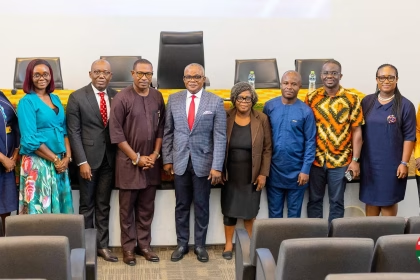
Speaking at a High-Level African Blue Food Leadership Roundtable, Emelia Arthur described blue foods as “a catalyst for resilience,” arguing that targeted investment in fisheries and aquaculture can support nutrition outcomes, livelihood creation, and climate adaptation across coastal and inland communities. She stressed that the sector remains central to Ghana’s broader food security strategy and increasingly relevant to Africa’s climate resilience agenda.

The minister also highlighted ongoing policy reforms, including efforts to “improve transparency” in fisheries governance and scale up enforcement against IUU fishing activities, which continue to pose risks to marine stock sustainability and sectoral revenue performance.
Ghana further called for stronger continental coordination, backing proposals for an African Network of Blue Food Champions to align investment, governance, and innovation priorities across participating countries. The roundtable brought together several high-level officials, including representatives from AUDA-NEPAD, Kenya, Namibia, Sierra Leone, and Iceland, alongside the UN Secretary-General’s Special Envoy for the Ocean, Peter Thomson.