Ghana is making its boldest bet yet on clean energy, unveiling $3.4 billion in investment opportunities aimed at transforming its power mix, cutting emissions, and unlocking a new wave of green jobs by 2030.
Under the government’s Energy Transition Framework, the country plans to add 400 megawatts of renewable power within the next five years. The projects will range from utility-scale solar, wind, and landfill gas plants to the distribution of 1.5 million clean cookstoves designed to curb household emissions.
Plans are also underway to expand solar street lighting from 100 kilometres to 400 kilometres, alongside the development of 400 solar-powered irrigation schemes covering 400,000 hectares of farmland.
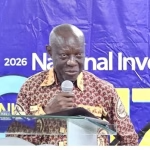
Mr. Seth Mahu, Director of Renewable Energy at the Ministry of Energy and Green Transition, said these initiatives will raise the share of renewables in Ghana’s generation mix from seven percent to 15% by 2030, while creating thousands of green jobs.
He was speaking at a Ghana–South Korea Business-to-Business seminar held under the Water–Energy–Food Nexus Project, which brought together policymakers and industry leaders to forge partnerships in climate resilience, food security, and sustainable energy access.

At the seminar, Korean companies showcased technologies that could accelerate Ghana’s transition, including thermal drones for predictive solar management, advanced solar monitoring systems, upland farming mechanisation tools, and off-grid renewable energy systems tailored to Africa’s diverse energy needs.
Mr. Mahu emphasised that Ghana is not only seeking to meet its climate targets but also positioning itself as a regional hub for clean technology production and distribution.
With Accra hosting the headquarters of the African Continental Free Trade Area, he noted that businesses that establish in Ghana will be able to serve the domestic market while gaining access to a continental marketplace of more than one billion people.
Unlike many African economies still struggling with basic energy access, Ghana has built a strong foundation. National electrification now exceeds 85 percent, with urban coverage at 98 percent and rural access standing at 71 percent and growing. By 2030, the government’s targets aim for 99.98 percent access, a level that would make Ghana second only to South Africa on the continent.
“This progress means that regardless of where businesses are located, they will have reliable access to electricity to run their investments,” Mr. Mahu said, describing the country’s energy infrastructure as a unique advantage for investors.
The investment drive is seen by analysts as a deliberate shift towards aligning climate action with economic competitiveness. By linking renewable energy to agriculture, manufacturing, and technology, the framework aims to draw in international green finance while reinforcing Ghana’s position as a climate-resilient investment hub.
However, the social impact is equally significant. Distributing clean cookstoves could save thousands of lives from indoor air pollution, while solar irrigation schemes promise to boost food security and shield farmers from erratic rainfall.
Importantly, the $3.4 billion pipeline is more than a renewable energy rollout. It is a strategic blueprint to fuel economic growth, build resilience, and establish Ghana as a gateway to Africa’s clean energy future.