

Amid the renewed debate over the cause of Ghana’s recent economic crisis, an economist at Academic City University, Dr. Paul Appiah Konadu, has thrown his weight behind the World Bank’s position that Ghana’s current economic crisis was not primarily caused by COVID-19 or the Russia-Ukraine war.
Despite the spirited defense by the former government that the crisis was caused by the global pandemic, which was exacerbated by the Russian war on Ukraine, the economist agrees with the World Bank that the economic mess was primarily the outcome of long-standing internal weaknesses.
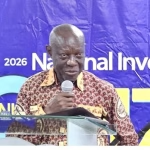
Speaking to The High Street Journal, Dr. Appiah Konadu argued that while the twin global shocks worsened the country’s plight, Ghana was already sliding into economic distress due to reckless borrowing and unsustainable debt levels.
“I agree with the World Bank. Yeah, our situation was not fully caused by the Russia-Ukraine crisis. No, we’re on our way to that economic ditch. The COVID and Russia-Ukraine crisis just escalated an already bad situation because we were borrowing so much. Our debt levels were already getting unsustainable,” he indicated.

He concluded that, “So, COVID and the Russia-Ukraine crisis just escalated it”.
This blunt assessment directly contradicts the narrative of the former government. For years, officials have maintained that Ghana was a victim of external misfortune rather than domestic mismanagement.
World Bank’s Consistent Position
For many who do not know the history, they may assume the World Bank is shifting position or being economical with the truth.
For years, the World Bank has been steadfast and consistent in its diagnosis of Ghana’s economic crisis. Long before COVID-19 and Russia’s invasion of Ukraine, the Bretton Woods institution had warned that Ghana’s economy was showing cracks.
Before the crisis in 2022, in 2020, the Bank cautioned that ballooning public debt, persistent fiscal deficits, and weak revenue mobilization were leaving the economy vulnerable to shocks.

The Bank’s latest clarification, emphasizing that the crisis was “homegrown,” is therefore not a shift in position but a reaffirmation of its long-standing concerns. In other words, the World Bank is not moving the goalposts; it is pointing to the same problems it highlighted years ago, only that the chickens have now come home to roost.
A Tale of Two Narratives
The debate may sound abstract to many Ghanaians, but in reality, it is not, as it hits close to home. It explains why, despite the government’s earlier assurances, prices of goods keep soaring, jobs remain scarce, and the cedi continues its rollercoaster against major currencies.
The contradiction in the narratives between a government eager to deflect blame and economists insisting on homegrown failings has real consequences for credibility and trust in policy leadership.

Dr. Appiah Konadu’s remarks add intellectual weight to the World Bank’s position and sharpen the uncomfortable truth that Ghana’s economic woes cannot be outsourced to global crises alone.
They are, at their core, the result of choices made at home to borrow excessively, spend beyond means, and ignore warning signals until the “global twin crises” just escalated an already precarious situation.


