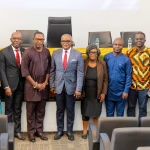
The African Centre for Technology Studies (ACTS) has launched the ACTS AI Institute (ACAII), a continental hub aimed at driving ethical, inclusive, and Africa-led artificial intelligence research and policy. Based in Kenya, the Institute seeks to ensure AI systems reflect the continent’s needs, values, and development priorities.
Supported by the AI for Development (AI4D) initiative, the Institute is positioned to lead responsible AI innovation across the region.
“The Institute builds on the support from the AI for Development (AI4D) program, supported by the International Development Research Centre (IDRC), Foreign, Commonwealth Development Office (FCDO), and the Swedish International Development Cooperation Agency (SIDA).
“We are proud of the work that the institute has done through the AI4D Scholarship Program, which is bridging AI divided by supporting researchers and innovators from historically disadvantaged communities to develop and scale AI solutions and to shape the African AI innovation system,” said Kathryn Toure, IDRC Director, Regional Office of Sub-Saharan Africa.
The Institute’s launch comes amid deepening cooperation between the African Union (AU) and the European Union (EU) on science, technology, and innovation. In a keynote address, Dr. Laurent Bochereau, Minister-Counsellor at the EU Delegation to the AU, highlighted the 25-year AU-EU partnership and the role of Horizon Europe, the EU’s €100 billion research program.

The program’s Africa Initiative III has allocated €500 million for 2025, with a call for proposals on generative AI tailored to African needs.
“We want to involve a lot of local startups in at least three to five African locations. And we want to involve end users from the very beginning. So this call (Africa Initiative III) is open. I know it is generating a lot of interest. And we hope that this will help develop solutions which are addressing African priorities, but also using knowledge and languages which are indigenous in Africa,” said Bochereau.

ACAII is structured around five core pillars: responsible AI solutions, AI policy and governance, AI and jobs, capacity building, and data science. These focus areas are intended to generate practical applications in agriculture, education, healthcare, and climate adaptation sectors critical to the continent’s development.
“The Institute builds on the experience and network consolidated over a period of five years, since ACTS started implementing projects related to development and deployment of responsible AI solutions and related policies. This launch is therefore meant to enable us to do what we have been doing better, with a wider mandate across the continent,” said Professor Tom Peter Migun Ogada, Executive Director of ACTS.
“We are involved in research and development of Africanized policy, standards, and ethics of AI. Specifically, we are already developing an Africanized scaling of responsible AI toolbox,” added Dr. Winston Ojenge, Principal Research Fellow and Head of the ACTS AI Institute.
One major goal is to help smallholder farmers, who represent more than 60% of Africa’s population, through tools like AI-powered weather prediction and crop yield modeling. The Institute is also adapting AI solutions for healthcare delivery in underserved rural areas.
“It is good that we are now talking about African centered AI future. We, thus, need to prioritize bridging that gap that has existed for many years. We need to begin to think from the policy side. How do we build the necessary infrastructure? We need local infrastructure. We need appropriate capacity building, which must be centered on people understanding what they need to do in order to transition from poverty to prosperity,” said Amb. Prof. Bitange Ndemo, Kenya’s Ambassador to Belgium.
Dr. Devotha Nyambo of the Nelson Mandela African Institution of Science and Technology emphasized the importance of improving data quality and relevance. “The limitation in infrastructure comes from the entire architecture and processes around data acquisition, the ability to process data, the ability to critically develop strong and robust models. But we also have a challenge in data. Our data is still disaggregated. The Institute has the opportunity to make sure that we are closing that gap and make sure we have disaggregated data more real time, but also localize the data that can represent our local context.”
Addressing Africa’s youth employment challenge is another priority. With over 60% of Africa’s population under 25, the Institute aims to use AI to create new jobs, stimulate entrepreneurship, and prepare the workforce for future industries.
“What we are looking to achieve collectively is to build an ecosystem in which responsible AI policies are adopted and implemented, and in which AI innovations are scaling their impact inclusively spreading the benefits of the tools to people that are most often left out of economic and particularly technological transformations.
“Many young people are looking for training and opportunities, and we have seen how important it is to support institutions across the region to guide that burst of activity towards responsible and inclusive AI, and to ensure that we are thinking about not only opportunity, but also about risks,” said Gillian Dowie, Senior Program Specialist at IDRC.
The Institute aligns its efforts with key African Union strategies including Agenda 2063, the Digital Transformation Strategy 2020–2030, and the Science, Technology and Innovation Strategy for Africa 2024.

“We are beginning to see an upsurge in digital numbers around the continent where the young people are using data centers to provide AI solutions to people within the continent. At AUDA-NEPAD level, we help support not just those working at the foundational level of AI, but those that have already leveraged AI to be able to commercialize it.
“I am happy that there is an opportunity for us to also look deeply at how African languages can begin to feature within this Institute,” said Prof Brando Okolo, Head of Science, Technology, and Innovation at AUDA-NEPAD.
The ACTS AI Institute is forging partnerships across governments, academia, civil society, the private sector, and the media to build a pan-African AI ecosystem rooted in responsibility and local ownership.