

Gold remains the leading export commodity from Ghana contributing the highest percentage of the total export earnings of the country.
Latest Summary of the Economic and Financial Data from the Bank of Ghana reveals that total earnings for Ghana’s exports stood at $16.5 billion. Gold exports alone contributed to $9.58 billion representing more than half of the total export earnings. In percentage terms, gold contributed a whopping 58% of the total exports of Ghana as of October 2024.
The performance of Gold appears to dwarf other key export commodities such as cocoa, crude oil, and other Non-Traditional Exports (NTEs).
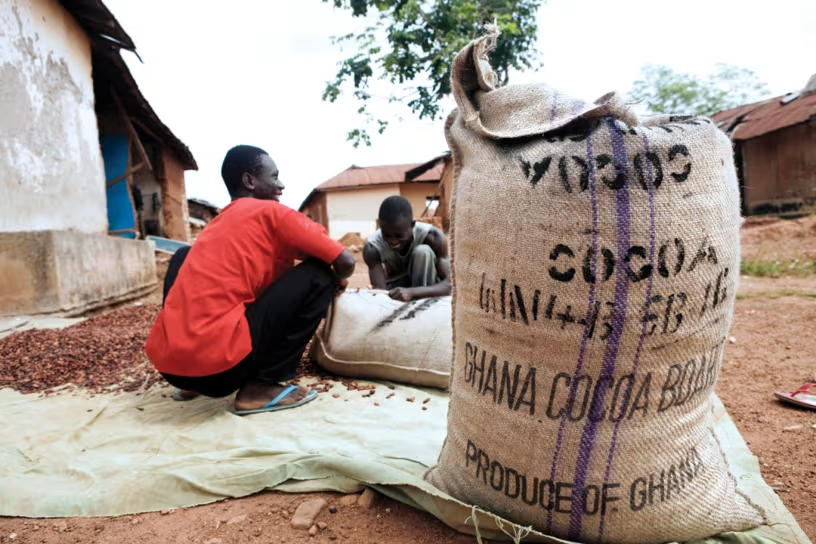
Cocoa, a traditional export commodity of Ghana, the BoG data says contributed just $1.15 billion which translates into 7% of the total exports. Crude oil exports also fetched the country $3.83 billion representing 23% of the total. The NTEs and other exports collectively earned $2.45 billion which accounted for the remaining 12% of the total exports.
The $9.58 billion earnings from gold should be a cause for celebration. Even Ghana’s current three-year IMF Extended Credit Facility is earning Ghana just $3 billion.

READ ALSO

However, here is the paradox – despite the huge earnings from gold declared by the Bank of Ghana, the country benefits from just a paltry fraction of the wealth generated by the mineral export. Much of the revenue from gold exports flows out of the country into the coffers of multinational mining companies.
With these corporations dominating the sector, Ghana earns relatively little from its most valuable export through royalties, taxes, and minimal local ownership stakes.
Banking Consultant and Financial Analyst, Dr. Richmond Atuahene confirms to The High Street Journal that the huge sums of export earnings reported by the Central Bank are just nominal values that do not wholly benefit Ghana.
He reveals that Ghana earns just around 14% of all the total earnings from gold. This stems from the kind of contractual agreements the country has signed with multinational companies.

“When the Bank of Ghana says gold export is 9.5 billion, the 9.5 billion do not enter into Bank of Ghana accounts. It’s a nominal value. I have a record. Last year, 2023, Bank of Ghana quoted 7.6 billion. It will shock you to know that it was only 1.2 billion that was captured by Bank of Ghana. I don’t know why they want to tell the whole world 9.5 billion. Calculate only 14% of it. The maximum is 14.8%. For us to know the amount that entered Ghana’s economy, we should calculate 14%,” he explained.
He further revealed that, “between 2014 and 2023, Ghana extracted 51.6 billion of gold for 10 years. Only 7.6 billion came into Bank of Ghana accounts over the same time period.”
This paints a darker picture of how a mineral-rich country like Ghana earns very little from its resource endowment leaving the state with limited resources to tackle pressing issues like poverty, education, and healthcare.
Meanwhile, communities near mining sites face environmental degradation, loss of livelihoods, and unsafe living conditions, painting a stark contrast to the glittering numbers on export reports.

The situation resonates with former Chief Justice of Ghana, Her Ladyship Justice Sophia Akuffo’s earlier sentiments about Ghana’s mineral agreements with multinational companies.
She questioned why Ghana continues to sign “colonial-era agreements” with its mineral resources which historically have yielded very limited economic benefits for Ghana.
The situation calls for a reworking of the country’s mining agreements to ensure the country benefits the most from its gold wealth. This could include renegotiating contracts to increase royalties and taxes, mandating higher local ownership of mining companies, and ensuring that a portion of export earnings is reinvested into the country.
Additionally, strengthening governance to reduce illicit financial flows and improving transparency in the gold sector could significantly boost government revenues.


