

Picture a Junior High School dropout, not more than 18 years old, standing deep in a galamsey pit somewhere in the Western Region. By the end of the week, he could walk away with anywhere between GH¢3,000 and GH¢10,000, amounting to between GH¢12,000 and GH¢40,000 a month.
Also, picture a university graduate at one of Ghana’s biggest media houses or an average Ghanaian graduate working anywhere, earning just a fraction of what the young JHS dropout galamseyer earns in a month.
This comparison is at the heart of Ghana’s illegal mining menace. Espoused by policy analyst Senyo Hosi, who is a well-known fierce critic of illegal small-scale mining, he maintains that Ghana cannot fight and win over the menace. However, it can only manage it through fixing the system.
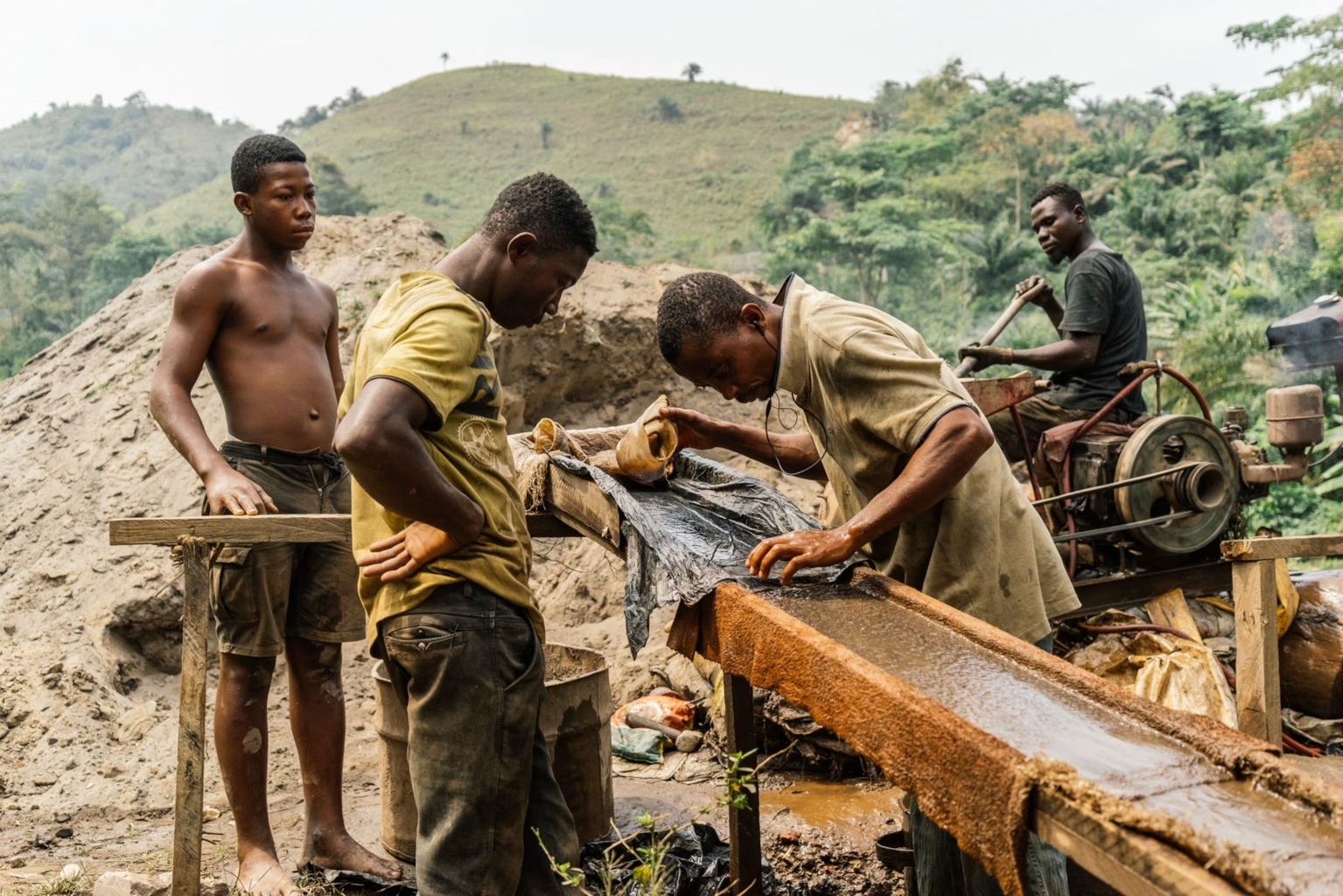
A Point of No Return
Senyo Hosi’s case is built less on morality than on arithmetic. Galamsey, he argues, has become so deeply stitched into livelihoods, politics, chieftaincy and even religious life that treating it purely as a crime to be crushed misses the point of the scale of the entire problem.

“The socio-economic reality is that galamsey has become a livelihood. It is so endemic you can hardly separate it from the path of politics, economics and community harmony. The chiefs are supporting it. The families are supporting it.” – Senyo Hosi remarked on JoyNews’ Newsfile on Saturday.
He points to gold’s outsized weight in the national economy, representing around 63% of Ghana’s total exports, making the country gold-dependent. The artisanal and small-scale (ASM) gold, he says, makes up more than half of the total export. And, he says bluntly, most of that ASM gold traces back to galamsey, whatever the official statistics claim.
“Galamsey is funding our politics. Galamsey is funding our churches. Galamsey is funding media… If we take the economy, and this is so fraught, and we are going to cut out a good part of it, the politicians don’t have the guts to get it done,” he noted.
For him, the surest path now is for the country to refocus from fighting to fixing. “I must be honest, our only path forward is fixing Galamsey, not fighting and stopping Galamsey. We can’t,” he emphasized.
How Fixing Offers the Best Chance to Sustainability
Senyo Hosi believes that by proper formalization of the illegal mining, the country will stand a better chance at addressing the environmental problems. He therefore proposes what can be described as a recovery-rate gap.
Galamsey operators, using rudimentary methods, typically recover only 30–40% of the gold in the ore they process. Formal large-scale miners, using proper technology and responsible processes, recover 90–95%. Rather than criminalising that gap away, Hosi wants to close it with investment, bringing galamsey operators into a regulated, technology-supported system that lifts their recovery rate toward 80%.
The extra gold recovered from the same ore, he argues, becomes the funding source for reform itself. This means the extra funds obtained from the efficiency introduced will pay for environmental reclamation and for the very equipment that reduces the damage in the first place.
Underneath the economics is a psychological observation many policymakers overlook. In his view, galamsey operators are not, by and large, proud of their outlaw status. What they are chasing, alongside income, is legitimacy.
“One of the things that the galamseyers seek is validation and recognition. They want legitimacy… They’re not proud of working around as galamseyers,” he noted.

Lessons from Tanzania’s Tanzanite
Hosi’s call for formalisation over confrontation is not a theory plucked from nowhere. Tanzania has already run a version of this experiment on tanzanite, which is the rare violet-blue gemstone found nowhere on earth except a small strip of hills near Mount Kilimanjaro.
The mineral, for a very long time, became the target of the same smuggling and informal-mining pressures galamsey creates around gold.
Facing losses that President John Magufuli once put at roughly 40% of total tanzanite production leaking out through smuggling, Tanzania didn’t simply arrest its way out of the problem. It restructured the entire value chain, combining enforcement with formalisation.
Physical and trade control: Government fenced off the Mererani mining blocks with a 24-kilometre wall; fitted with CCTV, electric wire and a single guarded entry point and, critically, moved wholesale tanzanite trading inside that perimeter under Central Bank oversight, so every stone passed through a traceable, taxable channel.
Legal ownership of the resource: A 2017 legislative package asserted state sovereignty over natural resources, gave government the power to renegotiate “unconscionable” mining contracts, and required a minimum 16% free-carried state equity stake in mining companies, rising as high as 50–66% in some tax-incentive cases.
Forced local value addition: Tanzania banned the export of rough, unprocessed tanzanite, pushing cutting and polishing to happen on Tanzanian soil instead of shipping raw stones to India and elsewhere for the real profit to be captured abroad.
Bringing the informal sector inside the tent: Rather than only prosecuting artisanal miners, the government introduced Mirerani Controlled Area regulations, issued primary mining licences to small-scale operators, ran centralised auctions, and is now building a Tanzanite Exchange Centre to anchor formal trade permanently at the source.
Continuous enforcement against holdouts: Formalisation did not mean amnesty for everyone. As recently as April 2026, Tanzania’s Mining Commission cancelled 40 exploration licences and put 43 more operators on a 30-day compliance notice, reclaiming idle land for redistribution to small-scale miners, women, youth and people with disabilities.

What Ghana Can Learn
The parallel to Senyo Hosi’s prescription is clear. Tanzania, instead of fighting to eradicate the menace, used licensing, monitoring, centralised trading and mandatory local value addition to pull an informal, high-value extractive sector into the formal economy.
It funded the transition, in part, from the value that formalisation itself unlocked, much as Hosi proposes using the recovery-rate differential to fund galamsey’s clean-up.
The Bottomline
Whether Ghana adopts anything resembling Tanzania’s model remains, for now, an open policy question rather than a settled direction. What Hosi’s intervention does is reframe the terms of the debate. It moves away from a binary fight-or-lose framing of galamsey, toward a harder conversation about whether regularisation, licensing, technology transfer, traceable trading centres, and a funding model built on recovered value.
This is believed to be the more realistic path, even if it is not the ideal one. Tanzania’s tanzanite story suggests such a pivot is possible, and that it can meaningfully reduce the degradation and help to capture more value from Ghana’s gold.


