Cocoa prices on the world market have surged to an eye‑watering $8,575 per tonne, raising hopes across Ghana’s cocoa‑growing communities that a major pay rise is coming when government sets the new farmgate price on August 7, the official start of the 2025/26 cocoa season.
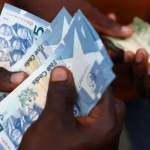
On paper, the maths looks tempting. At that world price, if Ghana applied its long‑promised 70% share for farmers, it would translate into roughly ₵3,900, a sharp jump from the current ₵3,100 per bag.
But that headline figure is unlikely to land in farmers’ pockets as neatly as it looks on paper. The first reason is the stronger cedi. Every dollar from cocoa sales now converts into fewer cedis than before, meaning the same $8,575 buys less in local currency terms. That exchange‑rate effect effectively puts a ceiling on how much of the world‑price increase can realistically show up in the producer price.
The second reason is Ghana’s pricing structure itself. Farmers receive 70% of export earnings, but the remaining 30% is retained by the government and COCOBOD for loan repayments, operational costs, and stabilisation funds. And much of Ghana’s cocoa is sold months in advance, locking in prices below today’s sky‑high spot levels.
This creates a difficult choice for the government. It can trim COCOBOD’s share of export earnings, cutting what is set aside for loan repayments, operations, and buffers, to deliver a bigger boost for farmers. Or it can maintain those margins and accept that the cedi’s strength has set an effective ceiling on how much the farmgate price can rise.


What is certain is that farmers will see an increase from the current ₵3,100 per bag. But the size of that increase will depend on how far the government is willing to go to break through the limits the stronger cedi has created, and how much of its own share it is prepared to sacrifice to do so.
For the country’s more than 800,000 cocoa‑farming families, the coming announcement, expected from Finance Minister Dr. Cassiel Ato Forson in the days ahead, will be more than just a new price. It will reveal how much of the global cocoa boom will truly trickle down to them, and how much will be trimmed away by the reality of a stronger cedi and Ghana’s revenue‑sharing formula.