

After battling record-high inflation and economic turbulence in recent years, the three month old government has set an ambitious target—to slash inflation from 23.1% to 11.9% by the end of 2025. While some may view this as overly optimistic, financial economist Prof. Lord Mensah of the University of Ghana Business School believes it is within reach, citing improving economic indicators.
“Yes, someone would say it’s overly ambitious, but looking at the rate at which interest rates, especially at the short-term end of the market have dropped over the past few months, I can tell you that there is a possibility of bringing inflation down to that level,” Prof. Mensah told The High Street Journal in an interview.
Ghana’s Inflation Trends: A Rollercoaster Ride
Ghana’s inflation rate has experienced sharp fluctuations in recent years. In 2022, inflation surged past 50%, reaching a two-decade high due to global supply chain disruptions, currency depreciation, and rising fuel prices. The situation improved in 2023, with inflation easing to around 25% by year-end as the cedi stabilized and food prices moderated. However, achieving an 11.9% inflation rate in 2025 will require sustained policy efforts.
The Government’s Strategy
To achieve this target, the government is focusing on fiscal discipline, exchange rate stability, and interventions in key inflation-driving sectors such as agriculture, transportation, and utilities. The Agriculture for Economic Transformation Agenda is expected to boost food production, reducing Ghana’s heavy reliance on imports and easing inflationary pressures.
Beyond inflation control, authorities are also projecting a 4% economic growth rate for 2025. Prof. Mensah described this target as realistic but cautioned that planned tax hikes in key sectors like mining and quarrying could slow economic momentum.
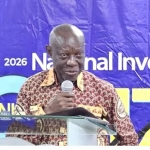

“Growing the economy by 4% is not overly ambitious. In fact, it is even lower than the growth we achieved last year. However, I understand where the minister is coming from—he is placing taxes on the main driver of last year’s growth, which is mining and quarrying. This could impact overall economic performance,” he explained.
Outlook: A Tough Road Ahead
Ghana’s economy has shown resilience, bouncing back from crisis levels over the past two years. GDP growth, which slowed to 3.2% in 2022 due to macroeconomic instability, recovered slightly in 2023 and is projected to improve further in 2024 and 2025. However, sustaining this recovery will require careful economic management, particularly in balancing inflation control with growth incentives.
Economist and Senior Lecturer at the Ghana Institute of Management and Public Administration (GIMPA), Dr Raziel Obeng-Okon is concerned about the usual focus of managers of the economy on fighting inflation, at the expense of growth. He told The High Street Journal, the Bank of Ghana must, as part of its mandate be genuinely interested and committed to the success and growth of businesses in Ghana.
“Too often in this country, businesses are overly regulated but left to fend for themselves; when you have high loan defaults you are on your on, you have to deal with the slow wheels of justice which become even more costly to you the business owner who is at the receiving end,” he lamented.
TUC on Inflation
Undoubtedly, bodies such as the Trades Union Congress (TUC) of Ghana is the least impressed with any such effort to reduce inflation to 11.9% . This is because the Union has consistently and persistently made its views on the inflation-targeting framework employed by the Bank of Ghana clear. The union has maintained that the pursuit of single digit inflation has impacts for growth and employment.
“The inflation targeting framework has become associated with restrictive monetary policy leading to high interest rates which stifle growth of local businesses due to high cost of borrowing. In our view, inflation in Ghana is primarily due to supply constraints or external shocks. That is the reason why inflation is usually low during the months of harvesting when food supply is in abundance,” the TUC submitted as part of its input into the 2025 budget.


