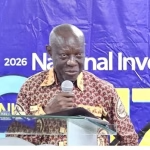
Ghana is intensifying efforts to advance its nuclear power agenda, targeting the completion of Phase Two of the programme and the commencement of preparatory activities for construction within the first term of the current project leadership.
Phase Two of the nuclear power programme focuses on critical groundwork, including site studies, public communication, institutional strengthening and vendor negotiations.
Successful completion of this phase will clear the path for Phase Three, the construction stage, under the International Atomic Energy Agency (IAEA) Milestones Approach.
Dr Archibold Buah-Kwofie, Director of the Nuclear Power Institute of the Ghana Atomic Energy Commission (GAEC), disclosed this in an interview with the Ghana News Agency in Accra.
According to him, the programme has reached a decisive stage where actions taken under Phase Two will significantly influence the speed and success of the construction phase.

“We have reached a very critical point in the programme. Phase Two is the project phase, and what we do now will determine how quickly we can transition into Phase Three, which is construction,” he said.
Dr Buah-Kwofie explained that his immediate goal is to help conclude most of the outstanding Phase Two activities while laying the groundwork for Phase Three.
These early steps include detailed site characterisation, strengthening project management and organisational structures, and supporting government in negotiations with potential vendors.
Public education and stakeholder engagement, he stressed, remain central to the programme’s success. To deepen understanding and address misconceptions about nuclear technology, the Institute is rolling out a nationwide Nuclear Information, Communication and Education Campaign.
The campaign seeks to broaden public awareness of nuclear science and technology, highlighting not only its role in electricity generation but also its applications in health, agriculture, industry and research.
“We want the public to appreciate the benefits of nuclear technology in a holistic way. It is not just about power generation; it has broader developmental impacts,” Dr Buah-Kwofie noted.
He further explained that the IAEA Milestones Approach provides a structured framework for countries seeking to introduce nuclear power.
The approach is divided into three progressive phases, each requiring the fulfilment of specific technical, legal, regulatory, financial and institutional conditions before moving forward.
Phase One involves preparatory studies and assessments to evaluate a country’s readiness to embark on a nuclear power programme.
Phase Two, currently underway in Ghana, focuses on detailed project development and infrastructure preparation. Phase Three marks the construction of the nuclear power plant.
The IAEA framework outlines 19 key infrastructure issues that countries must address across the phases. These requirements become more rigorous as a country advances toward plant construction and operation.
On Ghana’s overall progress, Dr Buah-Kwofie described it as steady but acknowledged that implementation has not moved as quickly as initially anticipated.
“Are we progressing? Yes. Are we progressing at the pace that we hoped? Maybe not,” he said, pointing to challenges that often confront developing countries pursuing nuclear power.
Among the major hurdles are funding constraints affecting key institutions involved in the programme.
He noted that nuclear power development competes with other pressing national priorities for limited financial resources.
“Funding is always a challenge because there are competing interests. However, this is a strategic national project, and we are hopeful that government will continue to prioritise it and secure the necessary funding to advance the required activities,” he stated.
Despite the constraints, Dr Buah-Kwofie said the programme continues to enjoy government backing and support from development partners.
He expressed optimism that sustained collaboration and improved resource mobilisation would accelerate implementation and bring Ghana closer to its goal of constructing its first nuclear power plant.
He also appealed to the media to play a proactive role in educating the public and ensuring accurate reporting on nuclear technology.
“Accurate information is crucial. We count on the media to help demystify nuclear technology and highlight its potential benefits to national development,” he added.