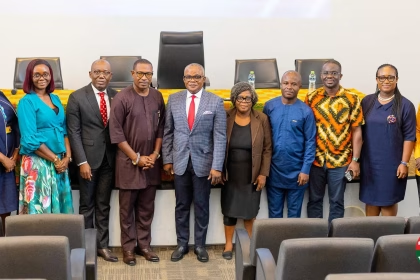
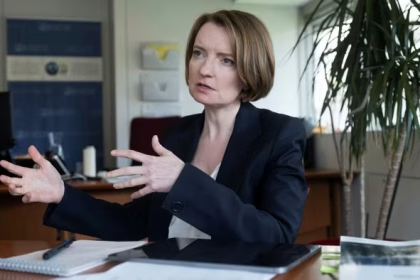
Ghana’s Finance Minister, Cassiel Ato Forson, has called for urgent economic reforms to address the country’s growing fiscal challenges, stressing the need for bold structural changes to reset the economy. Speaking at the National Economic Dialogue, the first of its kind in over a decade, he outlined the government’s strategy to stabilize the economy and set Ghana on a path to sustainable growth.
In his keynote address, Forson acknowledged the severe economic hardships facing Ghanaians, citing inflation, rising fuel and electricity costs, high-interest rates, and currency depreciation as major concerns. He stressed that despite some progress, the economic crisis is still unfolding, necessitating sacrifices from all stakeholders.
Forson also highlighted measures taken by President John Mahama’s administration to streamline government spending, including a reduction in the number of ministers from 123 to 60, budget cuts to the Office of the President, and a prohibition on first-class travel for government officials, as the “initial steps” toward fiscal discipline and good governance.
He also commended organized labor and the Ghana Employers Association for their cooperation in recent negotiations on the national minimum wage and base pay, reaffirming the government’s commitment to transparency and accountability.
The State of Ghana’s Economy

Dr. Forson provided an analysis of Ghana’s economic trajectory, pointing out that while the country experienced strong growth between 2000 and 2019, much of it was driven by oil and mining, accompanied by excessive debt accumulation. Public debt surged from 20% of GDP in 2006 to 93% in 2022, making the economy vulnerable to external shocks.

“The growth we have seen has not translated into structural transformation and productivity,” he noted, adding that Ghana’s economy remains overly reliant on primary exports such as gold, crude oil, and cocoa, which accounted for 85.1% of total exports in 2024. He warned that without urgent reforms, Ghana may not achieve upper middle-income status until after 2050.
He further outlined a seven-pillar approach to economic transformation, which includes:
1. Resetting the economy and creating prosperity for all
2. Job creation
3. Industrial revitalization and transformation through the GhanaFest initiative
4. Infrastructure development
5. Investing in human capital
6. Good governance and anti-corruption measures
7. Strengthening international economic relations
He also stressed that without comprehensive reforms, Ghana’s economic growth could slow to 3.8% per year within the next 15 years, a decline that would significantly impact job creation and overall economic stability.
Urgent Fiscal and Policy Reforms Needed
The Finance Minister also addressed the inefficiencies in public spending, pointing out that 70% of government expenditure is consumed by public sector wages, interest payments, and earmarked funds, leaving little room for development projects. He criticized inefficient spending in key sectors, including education, health, and infrastructure, and cited the stalled Agenda 111 hospital project as an example of poor resource allocation.
In the energy sector, Forson warned that mounting debts and inefficiencies at the Electricity Company of Ghana (ECG) pose a serious risk to the economy, with projected financial shortfalls exceeding $9 billion by 2026. He called for radical measures to restructure the sector and improve revenue collection.
Challenges in State-Owned Enterprises
Ghana’s cocoa sector is also under strain, with production dropping nearly 50% in the last three years. Forson revealed that existing forward sales contracts have resulted in revenue losses of $840 million, while smuggling of cocoa to neighboring countries has worsened due to pricing disparities. Additionally, Ghana Cocoa Board’s debt has reached $32.5 billion, with $9.7 billion due by September 2025.

State-owned enterprises (SOEs) remain a significant fiscal burden, with nearly all of them operating at a loss. Forson stated that many SOEs posted artificial profits in 2023 due to debt suspension, and he called for urgent restructuring to ensure financial sustainability.
Revenue Mobilization and Tax Reforms
To address Ghana’s revenue shortfall, Forson stressed the need for improved tax collection, particularly in value-added tax (VAT), which remains below regional benchmarks. He noted that tax exemptions are costing the country approximately 3.9% of GDP and called for a rationalization of the tax system to improve compliance and revenue generation.
Dr.Forson urged the need for bold and ambitious reforms to reset the economy and achieve sustainable growth. He urged all stakeholders, including policymakers, businesses, and labor groups, to contribute to the discussions and help shape policies that will drive Ghana’s economic recovery.
“This dialogue presents an opportunity to reflect on our economic reality, address present challenges, and chart a course toward a more prosperous future for our citizens,” he said.
The National Economic Dialogue is expected to generate policy recommendations that will inform Ghana’s forthcoming national budget, scheduled for presentation on March 11.