
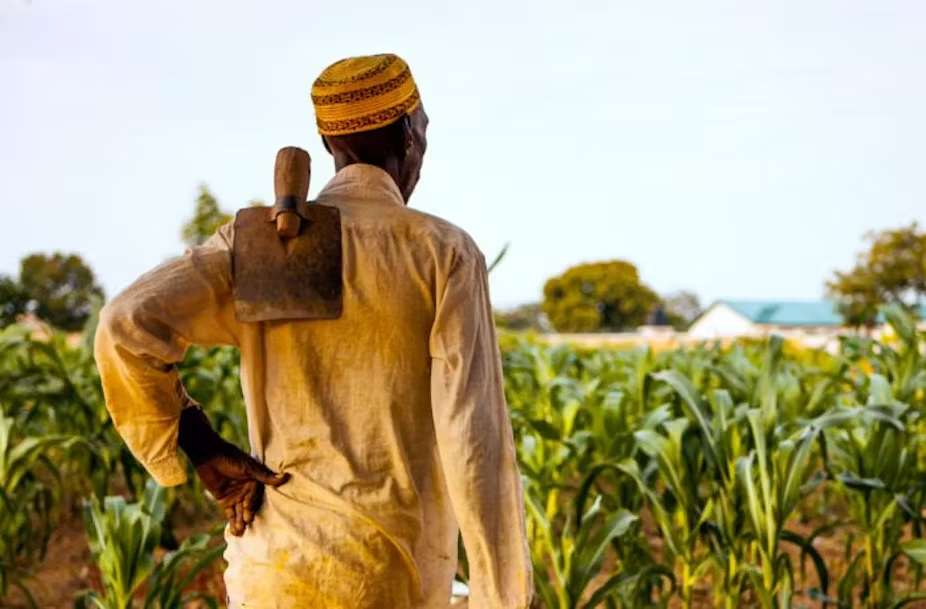
As Africa grapples with soaring population growth, food insecurity, and climate change, experts are sounding the alarm that the continent’s agricultural future hinges not only on new technologies but on better communication between scientists and policymakers.
This call emerged from the Second African Conference on Agricultural Technologies (ACAT 2025) held in Kigali, Rwanda, where leaders, scientists, and academics highlighted the widening gap between scientific innovation and political implementation.
Prof. Olalekan Akinbo, Acting Head of the Genome Editing Programme at the African Union Development Agency-NEPAD (AUDA-NEPAD), stressed that while Africa is producing cutting-edge research in biotechnology, much of it risks being ignored unless effectively translated into policy.
“We must communicate science in ways that are understandable and actionable for decision-makers,” Prof. Akinbo said. “Without this alignment, there’s a real risk that political interests will overshadow development priorities.”
The challenge, he argued, is not only about science but it is about narrative. Scientific institutions must learn to demystify biotechnology, frame it within national development goals, and highlight its potential to boost livelihoods. “Science communication is no longer optional,” he said. “It is strategic.”


Africa’s vulnerability is underscored by statistics. Ghana, for example, is projected to add over 2.25 million people to its population within five years. Yet, investment in agricultural innovation remains insufficient to meet this pressure. Without urgent action, the continent’s dream of zero hunger under Agenda 2063 could slip further from reach.
Prof. Eric Yirenkyi Danquah, Founding Director of the West Africa Centre for Crop Improvement (WACCI) at the University of Ghana, made an emotional plea at a regional stakeholders’ meeting in Accra. “Unless African leaders act boldly to transform agriculture, we will continue to fail our people,” he warned.
WACCI, since its founding in 2007, has become a hub for training Africa’s next generation of plant breeders. So far, it has graduated over 120 PhDs and 60 MPhil holders, who have contributed to the development of over 290 improved crop varieties. These varieties, now in the hands of farmers, are boosting food production across 15 African countries.
Notably, WACCI alumni are driving innovation at Ghana’s key agricultural institutions. Scientists such as Dr. Joseph Adjebeng-Danquah of CSIR-SARI and Dr. Ernest Baafi of CSIR-CRI are playing pivotal roles in research and development, including the recent regulatory approval of Ghana’s first genetically modified cowpea in 2024.
But progress is still cautious. “There are barriers,” Prof. Danquah admitted. “We need more funding, better regulatory support, and most importantly, political will.”
He emphasized that biotechnology is not a silver bullet, but a powerful tool that must be embraced with wisdom and urgency.
“We now have the ability to develop better crops faster to feed our growing populations and build resilience against climate shocks. But without strong political backing, that potential remains locked in labs.”
To bridge this gap, AUDA-NEPAD insists that science must be embedded into national policy structures.
Prof. Akinbo emphasized the importance of researchers working directly on government-priority technologies, and of national budgets reflecting a commitment to research.
“The African Union doesn’t work in isolation,” he said. “We support and empower national institutions to shape the continent’s agricultural agenda. But we need countries to show leadership. To secure Africa’s food future, aligning innovation with leadership is not optional, it is urgent,” he added.


